#20 A Comprehensive Study On Performance Practice In The First Movement Of Shostakovich‘s Cello Concerto No. 2, Op.126: Technical And Expressive Dimensions
UDC: 785.6:780.614.334
     78.071.1:929 Шостакович Д. Д
COBISS.SR-ID 188703497

Received: Mar 20, 2025
Reviewed: Jun 02, 2025
Accepted: Avg 25, 2025
#20 A Comprehensive Study On Performance Practice In The First Movement Of Shostakovich‘s Cello Concerto No. 2, Op.126: Technical And Expressive Dimensions
Citation: Wei, Wei. 2026. "A Comprehensive Study On Performance Practice In The First Movement Of Shostakovich‘s Cello Concerto No. 2, Op.126: Technical And Expressive Dimensions." Accelerando: Belgrade Journal of Music and Dance 11:20
Abstract
Dmitri Shostakovich's Cello Concerto No.2 in G, a representative work in his late years, is a treasure of cello masterworks in the 20th Century. This article is concerned about carding and analysis of the 1st Movement in various aspects such as social background of composing, music style, performing regularity, and technical difficulties etc., in order to have systematic performing annotation on relevant musical elements, and theoretical explanations to these significant structural connections between the 1st Movement and the whole work within grasp, on a basis of redemonstrating the writing purpose of the composer.
shostakovich, cello concerto no.2, artistic performance principles, technical difficulties, thematic development, morphological characteristics
Introduction
In the early 16th century, the cello emerged alongside harpsichord and bassoon as a fundamental basso continuo instrument in early sonata compositions. The 1697 sonata for harpsichord and cello by Italian cellist Giuseppe Jacchini stands as one of the earliest exemplars of this genre. With advancements in cello technique, numerous cellists and composers contributed to its development. Particularly influential was Luigi Boccherini, whose works substantially expanded the instrument's technical possibilities. His innovations included extending the solo cello's range up to B-flat, employing thumb position for double stops, rapid execution of scales and arpeggios, and sophisticated bowing techniques. These advancements not only catalyzed the proliferation of solo cello repertoire but also elevated the cello's status as an independent voice in chamber music.
During the Romantic era, improvements in piano manufacturing and technique facilitated significant development of cello-piano sonatas. Felix Mendelssohn's two cello sonatas (1838, 1842) demonstrated exemplary balance between piano and cello parts, while Frédéric Chopin's 1846 sonata achieved orchestral richness in its piano writing that rivaled concerto textures. Auguste Franchomme's sonatas and Johannes Brahms' two masterpieces further refined the timbral equilibrium between the instruments. Late 19th-century landmarks included Richard Strauss' vigorous sonata (1882), Edvard Grieg's solemn yet innovative work (1883), and Sergei Rachmaninoff's dramatically charged composition (1901). Julius Klengel's cello adaptation of
César Franck's violin sonata gained particular prominence among performers. David Popper's 48 Etudes emerged as essential technical literature comparable to Chopin's piano preludes, with his character pieces like Dance of the Elves remaining encore staples. The period's prolific output also encompassed concertos by Robert Schumann and Camille Saint-Saëns, alongside Tchaikovsky's Rococo Variations. Antonín Dvořák's emotionally charged Cello Concerto in B minor ultimately cemented the instrument's status as a formidable solo vehicle.
Technically, the Romantic period marked a zenith in cello performance practice. Pablo Casals revolutionized playing technique by liberating bow arms from rigid postures, enabling enhanced musical expression. His emphasis on harmonic-based intonation and rhythmic precision established new standards for pitch accuracy. These innovations fundamentally transformed cello pedagogy and performance traditions.
From a technical perspective, the Romantic period marked a zenith in cello performance art, during which bowing and left-hand techniques became substantially refined and systematized. The eminent cellist Pablo Casals revolutionized cello technique by liberating players' shoulders and bow arms from rigid postures through innovative performance approaches, thereby enhancing musical expressivity. His pioneering concepts of harmonic-based intonation and precise rhythmic internalization significantly elevated pitch accuracy standards. In recognition of his technical contributions, Arnold Schoenberg dedicated a cello concerto to him, later frequently performed by maestros including Yo-Yo Ma and Mstislav Rostropovich. Emanuel Feuermann's technical achievements paralleled Casals', particularly through his extraordinary left-hand dexterity that rivaled violin virtuosity, later forming legendary collaborations with Jascha Heifetz in America. This era definitively established the cello as a premier solo instrument.
The 20th century witnessed continuous technical innovations catalyzed by Casals' groundbreaking interpretations of Bach's Cello Suites and successive generations of virtuosi. As composers increasingly embraced the cello's solo potential, a wealth of repertoire emerged across diverse styles. Debussy's 1915 Cello Sonata pioneered post-Romantic compositional language, while Shostakovich's Cello Concerto No.1 in E-flat major, Op.107 (1959) introduced novel formal structures. Witold Lutosławski's 1970 Cello Concerto achieved canonical status through its avant-garde notation system, complemented by Alfred Schnittke's epic First Cello Concerto (1986) dedicated to Natalia Gutman, featuring transcendent chorale-like climaxes. Zoltán Kodály's Solo Sonata (1915) notably employed left-hand pizzicato accompaniment textures. This period saw composers increasingly adopting twelve-tone techniques and idiosyncratic musical languages, significantly expanding the cello's technical and expressive boundaries.
This paper contends that modern cello performance, through centuries of refinement, has attained technical apotheosis, with Shostakovich's Cello Concerto No.2 in G major standing as a paradigmatic 20th-century masterpiece. Focusing on thematic development, morphological characteristics, and performance conventions, the study specifically examines artistic performance principles in the solo cello part of the first movement.
Chapter I. Work Overview
(A) Composition Context
Dmitri Shostakovich was born on September 25, 1906, in a St. Petersburg apartment. As both a witness and participant in the 1917 Revolution, the young composer demonstrated acute awareness of historical upheavals through his early piano work Funeral March for Revolutionary Victims (1917), foreshadowing the profound "spiritual polyphony" that would permeate his lifelong creative ethos. Reflecting on his artistic journey in later years, Shostakovich asserted:
I am convinced that this revolution made me a composer. (Shostakovich 2005)
Following the completion of his Thirteenth Symphony (1962), Shostakovich focused on opera, folk song arrangements, and string quartets, producing the groundbreaking String Quartet No. 9 and No. 11. Despite critical acclaim for his formal innovations, he expressed artistic restlessness in Three Questions, One Answer (Shostakovich 1964), an article for Soviet Music magazine advocating for musical language as "free, natural, and capable of fully expressing emotional worlds—a power unique to music"(Danilevich 2010). Soviet violinist David Oistrakh marveled at his creative audacity:
As a violinist, I could scarcely imagine the performance techniques he discovered through his inexhaustible compositional imagination. (Shostakovich 2005)
By 1965, six years after his acclaimed Cello Concerto No. 1, Shostakovich began drafting Cello Concerto No. 2 with heightened deliberation. In correspondence with Isaak Davidovich, he revealed:
I am currently composing the Second Cello Concerto, with the first movement completed [...] The work comprises three movements, with the latter two played attacca. The climaxes in these movements bear an uncanny resemblance to the Odessan folk song Buy Some Bagels—though I cannot explain why [...] Rostropovich's image haunted me throughout the creative process; I earnestly desire his interpretation. (Danilevich op.cit.)
The composer later recounted struggling with the third movement's revisions, humorously describing his method:
I scribbled a full page recklessly, tormented listeners with my habitual ear for melodies, then plunged headlong into the Lethe River.
This reflects his relentless pursuit of the cello's unique expressive potential through virtuosic solo writing.
Premiered on September 25, 1966—Shostakovich's 60th birthday—by Mstislav Rostropovich under conductor Maxim Shostakovich, the concerto achieved immediate triumph. Composer Dmitri Kabalevsky praised it as "heroic labor made audible," while Rodion Shchedrin declared in Pravda:
We wholeheartedly wish the celebrated creator further new masterpieces. (Shchedrin 1966)
That year, Shostakovich received his third Order of Lenin and became the first Soviet composer awarded the title "Hero of Socialist Labor," cementing his legacy as a cultural icon.
(B) Stylistic Features of the Work
A defining characteristic of Shostakovich's late compositional philosophy lies in his dual capacity to critique societal contradictions while retaining hope and reverence for life. His musical language, as noted by scholar Lev Danilevich
embraces intimacy and concision in its most essential aspects, masterfully eschewing frivolity and irony in favor of courageous, ethically charged rational expressio. (Danilevich op.cit.)
This stylistic duality emerged against the backdrop of the composer's deteriorating health, infusing the concerto with profound tragedy and existential tension—a reflection of his conflicted psyche. For instance, the first movement's solo cello theme unfolds across contradictory musical planes, where systematic musical elements manifest through harmonic clashes and textural antagonism. The work's overarching narrative thrives on dialectical oppositions: the opening movement's introspective Adagio establishes a lyrical yet unstable thematic core, starkly contrasted by the second movement's agitated character. The finale synthesizes these extremes through metamorphic thematic development, ultimately collapsing into resignation and lament. Here, Shostakovich's dramatic language synthesizes irony and sorrow, sonically encoding his anguish, repression, and ideological ambivalence.
The "Parlando" Instrumental Style
The "parlando" (speech-like) technique, rooted in ancient European theatrical recitation, was reimagined by Shostakovich through a distinctly Russian folk idiom. In this concerto, the composer crafts a personalized rhythmic syntax by proportionally expanding or contracting note values within thematic structures, generating improvisatory effects that evoke oral storytelling.
Shostakovitch's innovative bowing techniques and timbral explorations amplify the cello's chameleonic expressivity. The solo part features extended melodic arcs characterized by metrical freedom, occasionally bordering on notated improvisation. Rostropovich aptly summarized the composer's approach: "Shostakovich possessed an insatiable curiosity for instrumental exploration." This concerto exemplifies his mastery in unlocking the cello's lyrical potential, transforming it into a polyphonic narrator through cantabile passages and textural dialogues with the orchestra.
Tonal and Harmonic Treatment
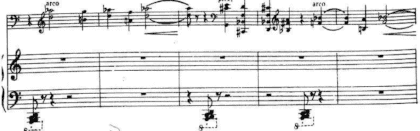
Shostakovich's Cello Concerto No. 2 employs harmonically dense and chromatically adventurous language, prioritizing coloristic effects over functional tonality. As shown in Example 1, the composer synthesizes diverse instrumental personas rarely unified in Romantic-era cello concertos.
Example 1.
Beyond the solo cello, he maximizes the expressive capabilities of woodwinds — assigning distinct thematic identities to horn, bassoon, and clarinet through extended solos that exploit their timbral uniqueness. Percussion instruments, including timpani, tambourine, and snare drum, amplify rhythmic urgency, heightening the cello's dramatic intensity through textural counterpoint.
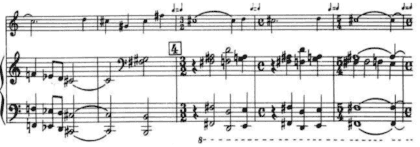
In the exposition, Shostakovich liberally utilizes all twelve pitch classes, anchored by a non-functional bassline that progresses through sequential patterns. Example 2 illustrates a characteristic bass motion (D–E♭–B♭–C) interspersed with dissonant chordal clusters and recurring non-harmonic tones. This approach destabilizes traditional tonal hierarchies, instead creating kaleidoscopic harmonic shifts that expand the cello's expressive scope.
Example 2.
Modal ambiguity further permeates the movement, with frequent shifts between diatonic, octatonic, and chromatic collections. Such techniques— rooted in melodic contour rather than harmonic function— reflect Shostakovich's modernist reimagining of tonal architecture, where tension arises from conflicting harmonic "zones" rather than cadential resolution.
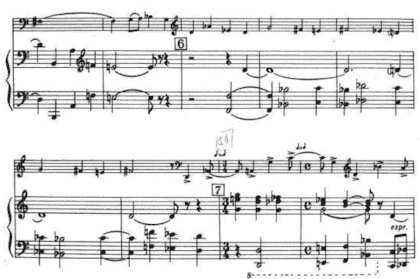
In the development section, Shostakovich demonstrates a nuanced application of modal systems, meticulously exploiting their latent expressive potential through structural reconfiguration.
Example 3.
Modal shifts frequently occur within a single thematic statement, sectional passage, or even individual phrases— exemplified in Example 3 by the abrupt transition from G major to C♯ minor. This technique destabilizes tonal expectations while enriching the music's emotional complexity, as contrasting modes imbue the same material with divergent affective connotations.
The composer extends this approach into subsequent movements, where polymodal juxtapositions and chromatic saturation further dissolve traditional tonal hierarchies. For instance, in the second movement's central climax, a folk-like melody undergoes modal metamorphosis, alternating between Lydian and Phrygian inflections to evoke shifting psychological states. Such practices reflect Shostakovich's broader modernist agenda: reconstructing diatonic materials into chromatically charged, emotionally ambiguous soundscapes that mirror the existential tensions of his late style.
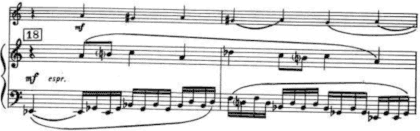
In transitional sections, Shostakovich characteristically employs lowered scale degrees to destabilize melodic trajectories, thereby complicating harmonic-modal relationships.
Example 4.
As illustrated in Example 4, a chromatic descent from B ♭ to G ♭ to E reconstitutes the melodic line's tonal orientation, introducing abrupt modal shifts through semitonal voice leading. This technique — rooted in the composer's penchant for intervallic compression— transforms diatonic phrases into harmonically ambiguous utterances, where descending chromaticism serves as both structural glue and expressive intensifier.
Chapter II. Performance Considerations
Thematic Analysis
Shostakovich's Cello Concerto No. 2 in G major features four thematically distinct yet interdependent subjects, whose motivic cyclicism propels the musical discourse throughout the first movement. Structured in three movements—Largo (G major) for the first, followed by two Allegretto movements—the concerto derives its architectural cohesion from the organic interrelation of thematic personalities, categories, and performance practices embedded in the solo cello part of the opening movement. This foundational movement not only establishes the work's ideological depth and compositional language but also presages the developmental trajectories of subsequent movements, making its systematic study critical for interpreting the concerto's philosophical and technical dimensions.
The four principal themes, characterized by starkly contrasting affective profiles, interact through motivic permutation to generate the first movement's narrative momentum. Their classifications and performative implications are outlined as follows:
1. Primary Theme: Dialogic Interplay with Orchestra
The movement opens with an extended solo cello theme in Largo, introduced in the instrument's lower register with a somber, muted timbre. Largely devoid of wide intervallic leaps, this melody functions as a leitmotif permeating the movement. Its rhetorical power stems from a call-and-response dialogue with the orchestra, wherein fragmented orchestral interjections (notably in winds and muted strings) refract the cello's introspective utterances. As Danilevich (op.cit.) observes, this thematic duality embodies Shostakovich's “spiritual polyphony”—a dialectic between private introspection and collective commentary. The cello's sustained espressivo phrasing demands meticulous bow control to balance the theme's inherent lyricism against its brooding chromatic inflections.
Example 5 (mm. 1–8) encapsulates the movement's conceptual nucleus, marked piano and espressivo—directives demanding restrained dynamic equilibrium and introspective lyricism. The thematic foundation, built on the dissonant chordal roots D–F–C♯–A♭ (enharmonically implying a diminished seventh complex), requires a timbrally unified delivery without excessive dynamic fluctuation.

Example 5. measures from 1 through 8.
At m. 8, the solo cello sustains a 13-beat G♯ (enharmonic A♭) tenuto, its muted, veiled timbre achieved through bow placement near the fingerboard (sul tasto). This sustained tone functions as a harmonic pivot, triggering the orchestra's entry with the primary motif, a moment demanding seamless timbral integration between soloist and ensemble. As the theme unfolds, Shostakovich intensifies its tragic character through accumulating dissonant intervals (minor seconds, augmented fourths) and registral extremes. Rostropovich's performance annotations emphasize “suppressed vibrato” in these passages to heighten the music's existential bleakness.
Example 6 illustrates the concerto's dialectical interplay: the cello introduces a chromatically charged line with non-harmonic tones, while the orchestra articulates syncopated sforzando attacks in offbeats, embodying structural antagonism. Performers must prioritize clarity of accidentals through methodical fingering choices, emphasizing non-harmonic tones via controlled bow pressure (index finger weighting).

Example 6.
As the cello navigates abrupt modulatory shifts, the orchestra insistently reiterates the tonic, culminating in the soloist's resignation, a prolonged diminuendo across multiple measures that returns to the primary theme, heightening the movement's tragic apex.
2. Secondary Theme: “Cantabile” and Poetic Abstraction
Shostakovich's integration of Russian folk elements manifests through lyrical natural minor melodies, at m. 217, the cello transitions from glissandi and harmonics to a diatonic melody, accompanied solely by harp arpeggios on weak beats. This texture, marked piano with restrained crescendi to mezzo-piano, creates an ethereal ambiance through metric ambiguity and timbral transparency.
The tempo here demands deliberate spaciousness, requiring performers to prioritize luftpausen (breath pauses) between phrases. Each note must resonate fully, with vibrato width adjusted to reflect the theme's folkloric simplicity. The harp's offbeat entries necessitate precise ensemble coordination to maintain the illusion of rhythmic fluidity.
3. Developmental Theme: “Dialogue” and “Monologue”.
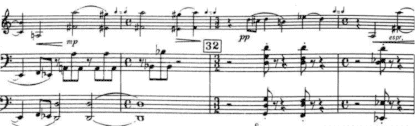
Example 7 delineates a phrase structured around the intervallic cell A–A♭–A, where the performer must execute a breath-like articulation after the initial A.
Example 7.
This requires controlled bow management: avoiding full bows by reserving the upper third of the bow for seamless phrase connectivity, creating an aural illusion of syntactic "punctuation." Simultaneously, the left-hand vibrato must remain continuous, with widened amplitude in high registers to project the melody's expansive lyricism. Technical precision is paramount here—narrow vibrato risks intonation instability, while excessive width may distort the folk-inspired simplicity.
The development section adopts a scherzo-like idiom, characterized by offbeat accents and dotted eighth-sixteenth note patterns that inject rhythmic caprice. In Example 8, the cello's spiccato sixteenth-note passages interlock with left-hand pizzicato, generating a luminous, quasi-theatrical exchange with the orchestra.

Example 8.
This contrapuntal banter—alternating between imitative dialogue and soloistic monologue—mirrors Shostakovich's penchant for dramatic juxtaposition. The orchestra's interjections (notably in bassoon and xylophone) parody the cello's motifs, creating a polyphonic labyrinth that demands acute ensemble synchronicity.
As shown in Example 8, the cello adopts a self-referential melodic discourse, alternating between low-register ruminations and high-register responses. Rapid position shifts in these passages risk intonational inaccuracy, necessitating deliberate slow practice to internalize tactile familiarity with intervals. In performance, the tempo accelerates colla passione, with staccato-marked eighth notes interrupting sixteenth-note legato runs—a bowing paradox demanding meticulous right-hand control. Performers must pre-establish internal rhythmic subdivisions to avoid metric destabilization, particularly during the orchestral interplay where the cello's offbeat forte entries contrast the ensemble's onbeat piano responses.
The technical crux lies in coordinating spiccato articulations: the bow must remain engaged with the string, utilizing its natural rebound to execute detached eighth notes before seamlessly transitioning to legato sixteenths. This scherzando texture, though whimsical superficially, conceals a contrapuntal rigor requiring absolute rhythmic discipline and timbral flexibility.
4. Transitional Theme: “Integration” and “Antagonism”
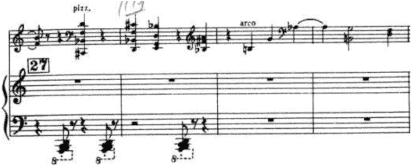
In the development's transitional passage (mm. 181–196, see Example 9), Shostakovich reduces the accompaniment to timpani alone, creating a stark textural dichotomy. The cello's angular melodic line—spanning from F to C♯ through dissonant intervals (augmented fourths, minor sevenths)—eschews linear lyricism in favor of fragmented, quasi-improvisatory gestures. Dynamic extremes (subito forte to pianissimo) amplify the music's emotional volatility, while the timpani's martellato interjections (on C and G) engage in a percussive duel with the cello's pizzicato and sul ponticello attacks.
Example 9.
This section epitomizes Shostakovich's dialectical approach: the cello's rhythmically free,harmonically unstable discourse clashes against the timpani's metric rigidity, symbolizing irreconcilable ideological conflict.The absence of melodic resolution—replaced by accumulating chromatic tension—mirrors the work's overarching narrative of existential struggle.
In climactic fortissimo passages, performers must deliver explosive accents through full-body engagement: rapid bow speed, extended bow strokes, and unwavering wrist stability to concentrate energy at the bow-string contact point. The left hand should employ vigorous vibrato with widened amplitude, while the bow remains positioned closer to the bridge to amplify brilliance in high registers. A coordinated interplay between both hands is critical—intense vibrato paired with controlled bow pressure ensures resonant projection, transforming technical rigor into visceral emotional expression.
Technical Challenges and Solutions
Intonation and Chordal Precision
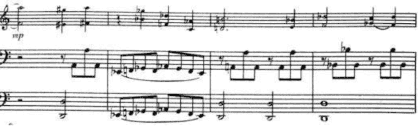
Shostakovich's harmonic language, characterized by dissonant intervals and wide melodic leaps, necessitates meticulous intonation adjustments during chord transitions. The use of unconventional fingerings exacerbates left-hand tension, particularly in passages featuring thirds, fifths, octaves, and twelfths (e.g.10, Example 10, mm. 225–228). To address these challenges:
Left-Hand Stabilization
Engage in fixed-position exercises to reinforce vertical finger alignment and ensure firm, perpendicular finger placement on the strings.Double-Stop Isolation: Deconstruct complex chords into individual voices during slow practice, prioritizing intervallic accuracy.Bow Control:
Example 10.
Focus the bow's contact point equidistant between strings to optimize resonance. Concentrate energy at the attack point for tonal clarity, avoiding excessive horizontal bow movement.Arm Posture: Lower the left arm deliberately to alleviate stiffness caused by elevated positioning, allowing natural weight distribution across the fingerboard.
Transitional sections in the concerto, marked by atonal melodic configurations, irregular intervallic leaps, and dense chromaticism (see Example 11), demand exceptional technical fluency. Key strategies include:

Example 11.
Positional Familiarity
Systematize fingerboard geography through scale and arpeggio drills, internalizing intervallic relationships to minimize hesitation during shifts.
Left-Hand Articulation
Strengthen finger independence with percussive "finger-drop" exercises, ensuring precise attacks and clean releases.
Bow Articulation
Maintain controlled rigidity in the right hand—utilize finger joints for rapid spiccato rebounds and avoid limp wrist movements. Fast retakes between notes prevent tonal diffusion, ensuring crisp articulation.
Dynamic Coordination
Synchronize left-hand shifts with bow speed adjustments to preserve rhythmic integrity and tonal focus, particularly in passages with abrupt dynamic contrasts.
Phrasing and Breath Management
At the beginning of the movement, after the cello slowly plays a two-bar introduction, the primary theme makes its first appearance. Despite its seemingly simple notation, the score is saturated with the composer's contradictory and sorrowful emotions. To convey this accurately, the performer must employ smooth bow strokes, gentle dynamics, and restrained left-hand vibrato. Example 12 (mm. 1–40) illustrates this thematic material, which expresses consistent emotional content and should be interpreted as a single large phrase.

Example 12.
When executing bow changes, the performer must prioritize the music's "breath" — even with rests, the musical narrative should flow uninterrupted. Audible traces of bow changes must be avoided; the wrist plays a critical role in maintaining continuity during transitions from frog to tip and back. This section also includes several sustained notes lasting 12 beats. When performing these long tones, it is common to subconsciously mark time with the right hand, but this disrupts the music's fluidity and coherence. Thus, the performer must keep the wrist steady, as even minor physical movements can interfere with bow control. Proper bow distribution is essential: avoid using excessive bow length for individual phrases to preserve flexibility and dynamic nuance.
Dynamic Expression
This work demands intense dynamic expression, where a single sustained note may traverse from pianissimo (pp) to fortissimo (ff), requiring exceptional bow control in the right hand. The composer imbues forte passages in high registers with a visceral urgency—a metaphorical "scream." To achieve this, the bow must be positioned closer to the bridge, paired with intensified left-hand vibrato to enhance tonal brilliance. In Example 13, mm. 140–150, the cello features numerous offbeat accents played exclusively with up-bows.

Example 13.
Typically, forte passages are executed near the frog for optimal control, as proximity to the bow's pivot point facilitates power. However, when playing in the upper half of the bow—farther from the pivot—a natural fulcrum must be established to gradually increase pressure without inducing harshness from excessive force. While technical mastery serves musical expression, and rigorous left- and right-hand practice refines execution, mere technical proficiency is insufficient.
Performers must deeply internalize the work's philosophical intent: deciphering the emotional narrative, determining initial bow pressure and articulation, and calibrating vibrato intensity. This concerto challenges not only technical prowess but also interpretative insight; only through penetrating its cryptic musical language can one fully realize its expressive potential.
Innovative Performance Techniques
Unconventional Rhythmic and Bowing Techniques
Unconventional Rhythmic Treatment
The composer abandons rigid rhythmic patterns, allowing the melody to organically alter tempo and pulse. The rhythm becomes fluid and variable, granting performers flexibility to accelerate or decelerate according to emotional demands. Compound meters dominate, with frequent metric shifts reflecting emotional volatility.

Example 14.
For instance, in the development section (Example 14, mm. 197–238)—a climactic outburst of conflict—the time signature alternates between 3/2 and 4/4 every two to three measures. Mixed meters (3/2, 5/4, 4/4) further destabilize the downbeat, creating aural tension. Such metric complexity, rare in traditional concertos, is accentuated by explicit notational cues for tempo transitions, enabling precise execution.
Bowing Techniques
Bowing patterns deviate from conventional norms, frequently employing cross-bar phrasing. Bow changes occur unpredictably on strong or weak beats, often staggered between hands, intensifying right-hand challenges.
Specialized Sound Effects
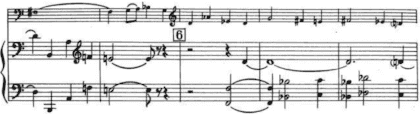
The composer employs extensive dissonant intervals, non-directional pitch sequences, and non-functional harmonies in the first movement, even creating harsh timbres that subvert traditional concerto lyricism. Melodic fragments lack cyclical or symmetrical development. For instance, in the exposition (Example 15, mm. 40–56), the melody expands in range with increased accidentals, avoiding rhythmic or intervallic repetition from bar to bar.
Example 15.
The harmonic trajectory grows ambiguous, destabilized by frequent remote modulations that imbue each measure with distinct tonal color. As critic Ivan Sollertinsky noted
Shostakovich's music converses—sometimes playfully, even mischievously—with its audience.
The composer's eponymous "Shostakovich mode," a hybrid of expanded tonality, microtonal shifts, and atonality—typically featuring flattened second, fourth, seventh, and octave degrees alongside altered fourths—represents a radical reimagining of musical syntax, challenging listeners to embrace new sonic paradigms.
Glissandi, Pizzicato, and Artificial Harmonics
Glissando Techniques
Shostakovich expands the cello's expressive palette by incorporating two types of glissandi: pizzicato glissandi and arco glissandi. The latter requires sustaining the initial note while the left hand slides upward or downward to a target pitch, maintaining full note duration.
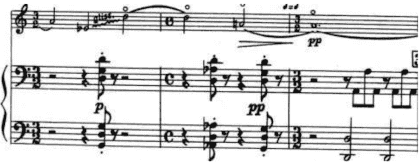
Example 16. Glissandi in mm. 210–220 with technical annotations.
Pizzicato and Harmonics
Both left-hand and right-hand pizzicato are utilized (see Example 17), with the latter often producing double stops and chords—unprecedented in earlier concertos. Right-hand pizzicato demands thumb stabilization on the fingerboard and forceful plucking with the index and middle fingers.
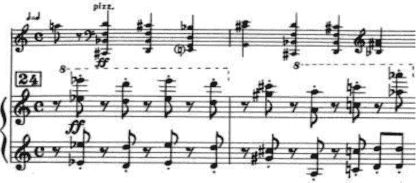
Example 17. Pizzicato techniques in mm. 165–170 with fingering diagrams.
Left-hand pizzicato, executed by plucking with the ring or pinky finger while fretting with the index or middle finger, prioritizes speed over volume, ideal for rapid passages. Artificial harmonics, primarily in high registers, require impeccable intonation: the thumb secures the fundamental pitch while the ring finger lightly touches the node point. Minute deviations disrupt harmonic clarity.
Conclusion
This study systematically organizes and summarizes the interplay between musical language and performance practice in the first movement of Shostakovich's Cello Concerto No. 2, with focused analysis on thematic development, technical innovations, and interpretative challenges. The 20th-century solo cello repertoire, reflecting global cultural crosscurrents, finds a paradigm in this work—where Shostakovich's dramatic idiom merges Russian folk elements with avant-garde techniques, redefining the instrument's expressive boundaries.
The first movement's performance practices, serving as a structural and thematic linchpin, exemplify how technical rigor (e.g., unconventional bowing, extended techniques) aligns with the concerto's overarching narrative. This analysis underscores a central thesis: virtuosic display remains subservient to the work's ideological core. The solo part's modernistic vocabulary—rich in extended techniques and notational symbols—not only enriches traditional cello performance but also informs contemporary compositional approaches. As Rostropovich observed, "Shostakovich was a precise architect of sound. His music demands that performers trace its hidden thread, a testament to his resilience amid lifelong trials"(Zong et al. 1987, 127). While this investigation provides a foundational framework for interpreting the concerto, further research into its socio-political subtexts and performative evolution remains essential.
References
- Danilevich, L. 2010. Shostakovich: Life and Works.
- Shchedrin, Rodion. 1966. Pravda, September 25, 1966.
- Shostakovich, Dmitri. 1964. “Three Questions, One Answer.” Soviet Music Magazine 1964.
- _____. 2001. Letters of Dmitri Shostakovich to Boris Tishchenko with the Addressee's Commentaries and Reminiscences. St. Petersburg: Compositor; 1st edition, January 1, 2001.
- _____. 2005. Letters.
- Sollertinsky, I. 1965. Shostakovich's Dialectics of Sound. Leningrad: State Music Press.
- Morton, Brian. 2022. Shostakovich (Life & Times). London: Haus Publishing; New edition, May 19, 2022.
- Zong, Bai, et al., eds. 1987. The Art of Cello Performance: World-renowned Cellists and Masterpieces. Shanghai: Shanghai Music Publishing House.
