#19 Not Permitted To Speak: Women And The Practice Of Aya-Fifa In Cherubim And Seraphim Movement Church (Ayo Ni O) Lagos, Nigeria
UDC: 316.662-055.2(669.1)
     305-055.2(669.1)
COBISS.SR-ID 188697865

Received: Nov 10, 2025
Reviewed: Dec 19, 2025
Accepted: Jan 08, 2026
#19 Not Permitted To Speak: Women And The Practice Of Aya-Fifa In Cherubim And Seraphim Movement Church (Ayo Ni O) Lagos, Nigeria
Citation: Loko, Omolara O. 2026. "Not Permitted To Speak: Women And The Practice Of Aya-Fifa In Cherubim And Seraphim Movement Church (Ayo Ni O) Lagos, Nigeria." Accelerando: Belgrade Journal of Music and Dance 11:19
Abstract
The old tradition of believing that women are inferior to men is fading away. The increasing visibility of women in social and cultural life in Nigeria attests to the changing dynamics of gender relations in the country. Although Apostle Paul emphasized in 1 Corinthians 14:34- 35 that women should not be permitted to speak in the church, an injunction that is reflected in many church doctrines around the world, recent developments suggest a movement towards gender parity regarding how responsibilities are apportioned in the church. Focusing on four selected branches of the Cherubim and Seraphim Church (Ayo ni o), Lagos, Nigeria, and drawing on ethnographic research comprising interviews, and participant observation, the paper discusses the role of women as enabled by an increasingly inclusive doctrinal authority of the Cherubim and Seraphim Church (Ayo ni o). Preliminary findings suggest that several women in the church under study engage the evolving power dynamics of gender relations with a strong sense of responsibility and empowerment despite subsisting challenges.
aya-fifa, cherubim and seraphim movement church, music, yoruba gender philosophy
Introduction
The Cherubim and Seraphim Church in Nigeria was founded by Saint Moses Orimolade Tunolase. Although, at its formative stage it became riddled with jealousies, disputes, and breakaways, characterized by splinter groups going their ways. There are hundreds of splinter groups scattered all over Nigeria each claiming to be the headquarters of the Cherubim and Seraphim Society of Nigeria. The urge to remain far away from controversies, disputes, and trivialities that hinder progress led to the formation of the Cherubim and Seraphim Movement Church in 1927. Despite the splintering tendencies of the Cherubim and Seraphim Church in Nigeria, it is noted that all the splinter groups adhered virtually to the same beliefs and practices.
The Cherubim and Seraphim Movement Church (CSMC) also adhered to the same beliefs and practices as the church embraces almost all the doctrines, especially those that involve women. Since its inception, there have been limits to women’s involvement in church activities, even when it was documented that the co-founder of the church was a woman by the name of Christianah Abiodun Akinsowon. Although, in the past many churches held on to Apostle Paul’s injunction on women not being permitted to talk in the church much less play any active role. Today, almost all churches engage women in all their activities, and many of these women also attained spiritual leadership positions in churches all over the world.
Of relevance to this study is the issue of gender. The geographic and cultural location of the Cherubim and Seraphim Movement Church in Yoruba land suggests the possibility of the impact of Yoruba gender practices (especially in sacred spaces) on the role of women in the church. Amid differing arguments about the Yoruba gender philosophy, one that may be relevant to this discussion is the one described by Oyeronke Olajubu (2012), who explains that pre-colonial Yoruba gender philosophy is defined by a complementary relationship between men and women. According to her
men and women were expected to perform certain roles, though boundaries for such prescription remained fluid. (Ibid.)
The author will discuss the relevance of Olajubu’s observation to the role of women in the C&S Movement Church in her conclusion.
Present research on women’s activities in CSMC revealed significant roles women are playing in various activities of many branches of the church. Special /Mother/in Israel/Prophetess Ogungbade Bolanle Felicia, the minister in charge of Temple of Joy Branch, Imeke (personal interview 7th January), explained that she got a divine call from the Lord but her Spiritual leader/general leader (Chairman of the District) told her that being a woman she would not be allowed to be the spiritual head of her branch but instead she should allow her husband to take the post of spiritual leader.
When the church was inaugurated, the husband was made the spiritual leader while she became the minister in charge of the branch. In the history of the church, women have not been allowed to take the post of a spiritual leader. Although she gave reasons why it was so, firstly, for purification’s sake, they believe during the menstrual circle of women, they are usually unclean, secondly, she said they believe women excesses are much, to an extent of being power drunk, she concluded that women are restricted from taking leadership role because of their seducing spirit against the men. Despite all these restrictions, women are still very vibrant and active in almost all the musical activities of CSMC, as women are mostly found in the musical activities of the four churches interviewed, one kept on wondering why the population of women in the church is very high, compared to that of men.
Loko (2015, 179-90) listed some areas of Cherubim and Seraphim Movement Church liturgical music in which women are involved, for example, being prompters, lead vocalists, spirit possession, composers, and instrumentalists. However, this list is not exhaustive. Furthermore, although scholars have already investigated the involvement of women in the liturgical music of the Cherubim and Seraphim Church Movement, certain aspects of their involvement have sparsely been examined. This research work, therefore, examines women’s involvement in Aya-Fifa (glos solalia) during the service, especially revival services. The author’s main focus is on the Shiloh service, which is highly dominated by women in all the branches interviewed.
Adejube and other scholars like Samarin, Mueller, and Endong have discussed glossolalia extensively from different perspectives (Adejube 2020, 158-173; Samarin 1968, 49-75; Mueller 1981, 185-193; Ending 2015, 14-20). Based on their assertions, glossolalia is defined as the act of speaking in an unknown language, also referred to as “speaking in tongues.” Glossolalia is one of the characteristics of Pentecostalism. It is also practiced in African Indigenous churches, including the Cherubim and Seraphim Movement Church. Although Adejube (op. cit., 160) called the Cherubim and Seraphim Church glossolalia practice an abridged version because it is not strictly speech-performed – it is a combination of melody and speech performance.
Definition of Terms
| Term | Definition |
|---|---|
| Unification | Coming together of various sects of Cherubim and Seraphim Church. |
| CSMC | Abbreviation of Cherubim and Seraphim Movement Church. A sect of unification. |
| C&S | Cherubim and Seraphim. |
| Af’edeFo | Someone who speaks in tongues or an unknown language. |
| Atumo | The name given to an interpreter of an unknown language. |
| AyaFifa | Melodically speaking in tongues, commonly found among the C&S Churches, quite different from other forms of speaking in tongues. |
| Aladura | The first title in Cherubim and Seraphim Church. |
| Alore | Someone who speaks in tongues, sees visions, interprets tongues, dreams, and visions but is not yet ordained to become a prophet (Daniel Band). |
Methodology
Through participatory observation in selected branches of the Cherubim and Seraphim Movement Church (CSMC) in Lagos State, Nigeria, few women were identified as playing prominent roles in the church activities, especially in the area of music. One aspect of the church that research has been neglected is the revival service which became a focus of this study. Six revival services were attended in four branches of the church. C & S New Glory, Perfection, Temple of Joy, and Independent Hill (Oke Ominira), all in the Badagry axis. During each service, the author observed the number of women in attendance and their roles in each ritual of the service. One-on-one interviews were carried out with active members of branches interviewed. One female minister in charge, two female choir masters, and two male pastors. All the people interviewed are either members of the choir or the Daniel band (Aloore) of the church.
A thorough examination of the Shiloh services (revival) reveals that the number of women attending the services is more than men (mostly women affairs). It was observed that women’s involvement in all the activities of the liturgy is very pronounced, especially in a branch where the minister in charge is a woman. Although, few men still play some prominent roles as instrumentalists and sound engineers.
Women and Jesus’ Ministry on Earth
Before the birth of Jesus Christ, there were many cases of women in the Old Testament who served in leadership capacities. In Exodus 15:20, Mariam, who was a prophetess served alongside his brothers Moses and Aaron, played an important role during the exodus from Egypt. Also, as recorded in Judges 4 & 5, Deborah was a judge, prophetess, and warrior that God used to deliver the children of Israel from the host of Sisera. Jesus in his time was surrounded by a host of women who believed so much in his ministry. They were there at his arrival on earth, during the fulfillment of his ministry, on his way to the cross, and at his grave and resurrection.
Oluwashola and Kolawole (2020, 1-10) explained how Jesus in his lifetime ministered to women in various capacities. Several examples in the Bible are listed. First and foremost was Anna the Asher, another woman, an elderly widow, who was constant in her daily prayer, always reminding others of the redemption prophecy that God promised for Israel. God rewarded her steadfast faith by giving her the privilege to see the Lord Jesus (Luke 2:36-40). He healed Peter’s mother-in-law and permitted her to minister unto him (Mark 1:30-31, Mathew 8:14-15 and Luke 4:38-39). Jesus had compassion on the widow of Nain whose only son died (Luke 7:11-15). Mary Magdalene was healed of evil spirits and she later became one the few female disciples of Jesus (Luke 8:1-2). Jesus healed the woman with the issue of blood and the woman with a spirit of infirmity for 18 years (Mark 5:24-34 and Luke 13:10-17). Likewise, he spoke the word of salvation to the Samaritan woman in such a way that Jesus satisfied her spiritual thirst (John 4).
The case of the adulterous woman who received forgiveness from Jesus (John 8:1-11). The Biblical illustration of Martha and her sister Mary was not left out, they were known as Jesus’s friends and opened their home for Jesus (Luke 10:38-42). Mary Magdalene, Joanna, and Mary, mother of James, and some other women were the first to discover that Jesus had risen (Luke 24:1-12). The same Mary Magdalene was the first to see Jesus after resurrection and she also spread the good news of Jesus’s resurrection (Mark 16:9-10).
All the above Biblical accounts revealed a series of miracles, signs, and wonders women enjoyed and their involvement in Jesus’s ministry. From all indications, these women encountered Jesus in one way or the other, and gradually, many became his followers. They were very genuine in their show of gratitude by ministering unto him in various capacities. The activities of these women in the ministry of Jesus have supported the assertion of Oluwashola and Kolawole that Jesus’s regard for women was much different from that of his contemporaries - he did not make a distinction between man and woman (Ibid., 5).
Today, women are still in the business of Jesus’ ministry. They believe so much in him to an extent they serve him with everything (money, intellect, talent, time, energy, and materials). The African Indigenous Churches in Nigeria that have not been giving women the upper hand in participating in the activities of the church have also yielded.
Shiloh Service in Cherubim and Seraphim Movement Church (Ayo ni o)
The Cherubim and Seraphim Movement churches are known for their mid-week services, which include Shiloh service, solution hour prayer service for the needy, protection service, healing and deliverance service, and covenant service. Loko (2023, 81-89) explained that the mid-week services of CSMC follow the same pattern with Sunday service but without processional and recessional hymns. The Shiloh service will be discussed extensively in this section.
Shiloh is a mid-week service that is observed in all the branches of Cherubim and Seraphim Movement Church (Ayo ni o). The days are different from one branch to the other branch. Judging from the branches interviewed, the service is observed on Tuesday, Wednesday, Thursday, and Friday respectively. For this study, Shiloh was observed because it’s a revival service that enables the flow of the Holy Spirit.
Shiloh Order of Service
- Call to worship - Jingling of the bell three times- Worship Leader
- Opening Hymn-Choir
- Opening prayer - Psalm 130 I. Prayer for Forgiveness II. Descent of the Holy Spirit III. Dedication of the place of worship, hearts, and worshipers IV. The Lord's Prayer V. Seal
- Thanksgiving Hymn Praise & worship - choir General Offering
- Thanksgiving Prayer
- Lesson
- Sermon/Prayer Ministration
- Revival
- Announcement/Divine Message
- Grace.
The above order of worship is observed in all the Cherubim and Seraphim Movement Churches during the Shiloh service. Days of worship may be quite different but the activities are the same. From the call to worship to the Grace, music is employed during the Shiloh service to accompany each activity of the program.
Significance of Aya-Fifa
The Redeemed Christian Church of God Sunday school manual (2021/2022) describes the Holy Spirit as the seed of God’s power planted in a believer when such believer is baptized in the Holy Spirit (Acts 1:8). Oje (2017, 51-57) opined that Aya-Fifa is principally used to commune with God and fellow Aaronites that are inspired to understand it.
Special Mother in Israel/Prophetess Ogungbade said
Aya-Fifa is employed in our services to help in inviting the Holy Spirit into our midst, there is no one in the service that will not feel the flow of the Holy Spirit at that particular session of its manifestation.
To buttress her point, Sister Rukayat in New Glory branch said
whenever the revival song is going on in a service, the Aya is used to ignite the fire of the Holy Spirit in members of Daniel band and this aids the heavy flow of the Holy Spirit when they are speaking the unknown tongues and also gives the interpreter more understanding of the unknown tongues.
Who takes part in Aya-Fifa?
As it was revealed through interviews with members of the church, Sister Moses Remilekun of the Independent Hill branch of CSMC said
Aya-Fifa is a special gift from God and not from any man.
She explained how she got the gift at the age of ten. In her narratives, she said that
one evening my mother was singing worship songs as she loves doing and within a twinkle of an eye, I started feeling strange that I have to quickly inform my mother, but she never stopped singing, all I was told later was that I went into a trance that same day, and I began to speak in tongues, interpret the tongue and also engaged in Aya-Fifa.
Pastor Elijah of the Perfection branch said
Anybody can be involved in Aya-Fifa, children, adults, male and female, it’s a gift that does not segregate. God gives the gift to whoever He wishes, if you’re given, you’re given, and if you’re not, you cannot forge it.
He gave an example of a little girl of about twelve years who went into a trance and rounded it up with Aya-Fifa. He also said he received the gift at a younger age. For Special/Mother/In/Israel/Prophetess Ogungbade of Temple of Joy branch also gave her voice on this session that the gift of Aya-Fifa is for the Spiritualists who are in Daniel band, she said
Not everybody in Daniel band is gifted in Aya-Fifa, some are seers, dreamers, and interpreters, but if you have the gift, you will definitely and automatically be a member of Daniel band. You cannot copy, mimic, and forge the gift. God can endow anybody with the gift.
In conclusion, God gives the gift freely to anyone He pleases, be it male, female, young, or old. For there is no respect of persons with God (Romans 2:11).
Women Involvement in Aya-Fifa in CSMC
Aya-fifa is a unique genre of melodically speaking unknown tongue. Despite the various versions of the origin of Aya-fifa, they all still mentioned a woman as the first person to speak in tongues in Cherubim and Seraphim. Oje traced the origin to when Captain Abiodun Christianah Akinsowon (co-founder of C&S) went into a trance and started speaking in an unknown language. She was a member of one of the Mission churches where speaking in tongues was out rightly prohibited, it was not part of the doctrinal injunction of those churches (Ibid.).
Looking at the various bands (societies) in CSMC, there is a particular band strictly for those who speak in tongues, see visions, and interpret, it is called Daniel Band but in other Cherubim and Seraphim Churches, it is called Alore. Members of Daniel band are not ordained ministers, they are seen as apprentices in the school of the prophets but immediately they are ordained, they become prophets and prophetesses and then cease to be members of Daniel’s band. This band is not restricted to any particular gender, it’s a band for both males and females, which is why all the members of the church that engage in Aya-Fifa are also in Daniel’s band except the ordained ministers. From the interviews carried out, it was observed that some of the choir members of the four churches are involved in Aya-Fifa.
A female choirmaster in the New Glory branch, Mother/In/Israel/Prophetess M.A. Babarinsa is a Prophetess, who speaks in tongues, interprets tongues, and engages in Aya-Fifa. During this research, the author visited her church on the first Wednesday in January 2024, to observe the Shiloh service. As a choir member, she was the lead singer in that service and as she began to lead in praise worship, she diverted to revival songs and suddenly, the Holy Spirit came down and descended on some members of the choir and congregation, and they began to speak in tongues. The author observed they were mostly women. The ushers led them out, and immediately the lead singer started Aya-Fifa, which also led the women to flow heavily in the unknown tongues. The same lead singer who engaged in Aya-Fifa was the one who interpreted their tongues.
From all indications, all the women interviewed are involved in Aya-Fifa, except the choirmaster of the Perfection branch. The Special /Mother/In/ Israel/Prophetess (S/M/I/I/P) Ogungbade was very fluent in Aya-Fifa. During the revival session of Shiloh service of New Glory that the author attended on the 30th of January, 2024, the Daniel band members were invited for their thanksgiving. In the process of dancing forward, the choir started singing revival songs for them. Immediately, the presence of the Holy Spirit was felt to an extent that five women began to speak in different tongues. It was then S/M/I/I/P. Ogungbade engaged in Aya-Fifa and also interpreted their tongues.
Sister Moses Remilekun of the Independent Hill branch of the church said
There is no revival service where I don’t experience the gift of the Holy Spirit which is manifested through Aya-Fifa, except if I didn’t prepare myself for the touch of God in that service.
She further explained that women are often found in this act of Aya-Fifa because they are emotional compared to men and that is why during the performances of revival songs the Daniel band members easily flow in the spirit.
Deaconess Adesola Oyenike who is a female Choirmaster of the Perfection branch said as a member of Daniel band she is not gifted in Aya-Fifa but she speaks in other tongues and also interprets. During the interview, she disclosed that many of her choir members who are female are gifted in Aya-Fifa and they are very fluent in the gift because they are choristers. This means any chorister who has the gift of Aya-Fifa will do greater exploits during the manifestation of the Holy Spirit. However, according to Oje, the people who perform Aya are not necessarily musically inclined but they do it spontaneously according to divine inspiration (Ibid.). From all the above submissions, women play active roles in Aya-Fifa in all the branches of Cherubim and Seraphim Movement Churches.
Aya-Fifa, Amplifier of Women Voices in CSMC
Based on the ongoing research, in all ramifications, the organizational structure of Cherubim and Seraphim Church Movement does not give the same opportunity to her members. There is gender disparity whereby the female members do not have the same access to status/position in the church as men do. It is quite glaring that the women are denied the pulpit but their voices are heard through music.
Over seventeen years that the author has been researching on the liturgical music of CSMC, women are mostly found in the limelight of the church musical practices. As earlier discussed that women are mostly involved in Aya-Fifa than men, it has become a platform where their voices are heard often. Either genuine or counterfeit, Aya-Fifa has created a space for women's voices not only to be heard in the church but also significantly amplified. Several times in the program for the day, women are not included, that is their voices are not to be heard leading any ritual of the liturgy but in the course of it, they usually manifest the gift of the Holy Spirit, called Aya-Fifa. Many of the women interviewed testified to this fact, especially S/M/I/I/P Ogungbade, she said no one can predict when the Holy Spirit moves in a service, all they do is prepare themselves, both men and women for the service. She discussed how often women who were not to be heard during service became a medium of expression by the Holy Spirit through Aya-Fifa, the amplifier of women voices in Cherubim and Seraphim Church Movement.
Aya-Fifa Implications to Gender Equality and Empowerment
From all indications, Aya-Fifa is a spiritual exercise that women play prominent role in all the Cherubim and Seraphim Movement Church (Ayo ni o). To the women, their involvement in Aya-Fifa is seen as a call to service which is being carried out in fear and trembling. The women involved in this ritual do it in reverence to the Almighty God, as the utterance is more like the voice of God. These were the same women who are neither expected to speak nor allowed to carry out any spiritual activity in the church but the gift of Aya-Fifa was given to them freely, and through this medium the women are projecting the voice of God. This activity has equalized both the men and women, often times, women are even more involved in it than their male counterparts. It has become a space for the women to navigate their spiritual suppression.
Short Profile of Three among the Women Interviewed
There is a need to have a short profile of a few of the women interviewed, although many did not want to disclose their identities. Therefore, this study gives a brief profile of three of the women interviewed. They are S/M/I/I/P / B. F. Ogungbade, Deaconess Adesola Rukayat Oyenike and Aladura Adesola Temitope Racheal.
Interviews
| Names | Venue | Date |
|---|---|---|
| Aladura Rukayat | C&S New Glory Branch | 07/01/2024 06/02/2024 |
| M/I/I/P Babarinsa, M.A. | C&S New Glory Branch | 07/01/2024 |
| Pastor Elijah | C&S Perfection Branch | 21/01/2024 23/02/2024 |
| Deaconess Adesola, R.O. | C&S Perfection Branch | 21/01/2024 23/02/2024 |
| S/M/I/I/P Ogungbade, B.F | C&S Temple of Joy Branch | 07/02/2024 |
| Aladura Moses Remilekun | C&S Independent Hill Branch | 13/02/2024 |
Note: Interviews of the past years on Cherubim and Seraphim Movement Church (Ayo ni o) were also of great importance to this current research.
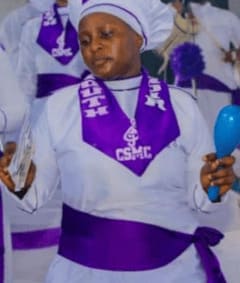
Special/ Mother/ In/ Israel/ Prophetess B. F. Ogungbade (JP)
Special Mother in Israel Prophetess (Sp/M/I/I Pro.) B. F. Ogungbade (JP) was born into a devoted Muslim family. According to her, her mother had a delay in childbearing in marriage, she usually sneaked out of the house to a C&S church seeking spiritual guidance without the permission of her husband, although it was one of her father's siblings that took her mother to the church.

Picture 1. Special/Mother/In/Israel/Prophetess B. F. Ogungbade (JP)
Her mother received a revelation from the cleric that she would give birth to a child that would work for God. After the prayer her mother gave birth to her and other five children.
However, her mother had forgotten the Divine message, and the family was still very devoted to the Islamic religion. One strange thing Ogungbade was known for in the family was her usual warning that always came to pass either positively or negatively. Because of this fact, her family members always heed her warning. She became a C&S member when her brother fell sick (he was taken to a Muslim cleric for prayers but to no avail; he was also referred to a hospital at Academy in Ibadan, but still yielded no result) B.F. Ogungbade advised her mother to take him to church. Behold in C&S Church her brother was healed completely and that was how the family members became C&S members. Although not too committed and serious in the new religion. Ogungbade was in and out of it because her father was a Devoted Muslim.
In the year 1994, she became a devoted Christian and C&S member when she got married. She said the day she wore the white garment was the day she received the gift of the Holy Spirit. After that, she went on trance and since then she has been working for God according to the revelation given to her mother before her birth. It was when she went into a trance she received the gift of "Aya- Fifa". She said the only way to grow in "Aya" is through fasting and prayer, that it cannot be learned or copied, it is a gift from God.
Deaconess Adesola Rukayat Oyenike
Adesola Rukayat Oyenike was born into a Muslim home, although her father was not a practicing Muslim. She occasionally attended Catholic Church without the knowledge and approval of her father. Her mother too was always sneaking out to attend services at Cherubim and Seraphim Church, in search of spiritual guidance. Oyenike said, on one faithful day her father came home and told her mother that he had seen a signboard showing the address of C&S church (Irawo Ogo Olohun o seun ti), and that was how the entire member of the family became devoted and committed members of the church.
Picture 2. Deaconess Adesola Rukayat Oyenike
Her father became the Secretary of the church and also the Choirmaster. Being a Theatre art practitioner, he would teach the choir songs, and take them out for competitions. Oftentimes they came first in position. She proudly said that she learned a lot of leadership skills and styles of teaching songs from her father. Her father also trained her to be a prompter (Hymn caller) and dancer in the choir: this has been the ministry she renders her services to God to date. She became a Choir mistress in the year 2013, and she had about thirty-five members in her Choir at CSMC, City of Comfort Branch where she served for eight years. She trained five children as a prompter, and they are still very active today. Also, she organized Praise and Prophetic Night, Choir Day, and Choir Anniversaries to mention a few.
All these achievements gave her an edge in Unification where she’s also serving in the central choir, Badagry local division. Two of the children she trained had won the best chorister of the year two times. She said to the glory of God she’s waxing stronger. Presently, she’s serving in CSMC, Perfection Branch, she started with the Branch in the year 2019 till date. She said her goal is to groom choristers that are rooted in the word of God, and more passionate when it comes to praising God.
Aladura Adesola Temitope Racheal
Adesola Rukayat Temitope was baptized to be an Aladura in Cherubim and Seraphim Church Movement Ayo nio. Her current position in the church is Vice Captain of Daniel Band (Spiritualist) and the secretary of the Women’s fellowship, Perfection Branch. According to her, she met Christ in the year 2012 in school when she attended a fellowship for prayer. Although her mother had been taking her and her siblings to church when they were very little, her father and his family members never approved of it, being Muslims. She emphasized how the father would usually force them to attend Arabic school which they were never interested in because of the way the so-called 'Alfa' (Arabic teachers) beat and bully them in the name of teaching and learning.

Picture 3. Aladura AdesolaTemitope Racheal
In 2012, she received the Gift of speaking in Tongues through Baptism of the Holy Spirit (this was the same year after her conversion). Explaining her experience with the Holy Spirit, she said
I never knew what happened to me that very day. It was later narrated to me by my siblings that I scattered almost all the chairs in the church shouting "Ra". That was the first tongue I spoke before going on three days' trance the same year. I later moved from the Church to CSMC, where I met my husband in the year 2015. With the help of God we started our Ministry in the year 2019.
"Aya-Fifa" is another level of speaking in tongues that she received (spiritual gift) from God. She said not everybody that speaks in tongues can "faaya", it's an inspiration from God.
Conclusion
Truly the gift of Aya-Fifa can be given to any member of CSMC through the inspiration of the Holy Spirit. It was observed that many people who manifest this gift in the church were formerly Muslims before their conversion. One way or the other, their stories were almost the same. They all had challenges that brought them to Cherubim and Seraphim Movement Church. Although Pastor Elijah disclosed during an interview with him that many are faking the gift of Aya, in Daniel band, such people can easily be identified and cautioned. Perhaps more importantly, the visibility of women in Aya-Fifa and musical activities through the choir demonstrates the complementary roles that women perform in the church along with men. However, the prominence of women in spiritual activities in the CSMC bears comparison with the spiritual strength of women in Yoruba societies. Concerning the role of women in the Yoruba Oshun religious practice in the Yoruba city of Oshogbo, Bode Omojola has, for example, observed that the authority of Ataoja (King of Oshogbo) is “enabled by spiritually powerful women whose actions and voices activate and embody the divine power of Ò̩s̩un” (Omojola 2012).
References
- Adejube, S. A. 2020. “Glossolalia: The Practice of Singing in Tongues in Nigerian Pentecostal Churches.” Journal of Christian Musicology, (1): 158-173. researchgate.net
- Endong, F. P. C. 2015. “Glossolalia in the Nigerian Gospel Music: Aesthetic Feature of the Archetype of a Pentecostal Identity?” International Journal of Arts and Humanity Science (IJAHS), 2(2): 14-20.
- Loko, O. O. 2015. “Feminity in Christian Liturgy: The Involvement of Women in Liturgical Music of Cherubim and Seraphim Church Movement (Ayo Ni o) Lagos.” Awka Journal of Research in Music and the Arts (AJRMA), (11): 179-90.
- _____. 2023. “Traditions and Innovations in the Liturgical Music of the Cherubim and Seraphim Movement Church (Ayo ni o), Lagos State.” African Musicology Online, 12(2): 81-89.
- Mueller, R. 1981. “A Linguistic Analysis of Glossolalia.” Concordia Theological Quarterly, 45(3): 185-193.
- Oje, Tosin Elijah. 2017. “Aya-Fifa: A Liturgical Music in Cherubim and Seraphim Church.” MAIDJAD, Maiden Edition March (2017): 51-57. academia.edu
- Olajubu, Oyeronke. 2012. Women in the Yoruba Religious Sphere. Albany: State University of New York Press.
- Oluwashola, J. P., and O. P. Kolawole. 2020. “Women in Jesus’ Ministry and the Place of Women in Contemporary Christian Ministry.” The American Journal of Biblical Theology, 21 (40): 1-10. academia.edu
- Omojola, Bode. 2012. Yoruba Music in the Twentieth Century: Identity, Agency, and Performance Practice. Rochester: University of Rochester Press. doi
- Samarin, W. J. 1968. “The Linguisticality of Glossolalia.” The Hartford Quarterly, 8(4): 49–75. Hartford Seminary Foundation, Hartford, Conn. utoronto.scholaris.ca
- ____. 1972. Tongues of Men and Angels: The Religious Language of Pentecostalism. New York: Macmillan.
